Signs Your Vinyl Pool Liner Is Near the End of Its Life
Vinyl liners don't last forever. Here's what to watch for, and what happens once you decide it's time.
September 16, 2026 · 4 min read
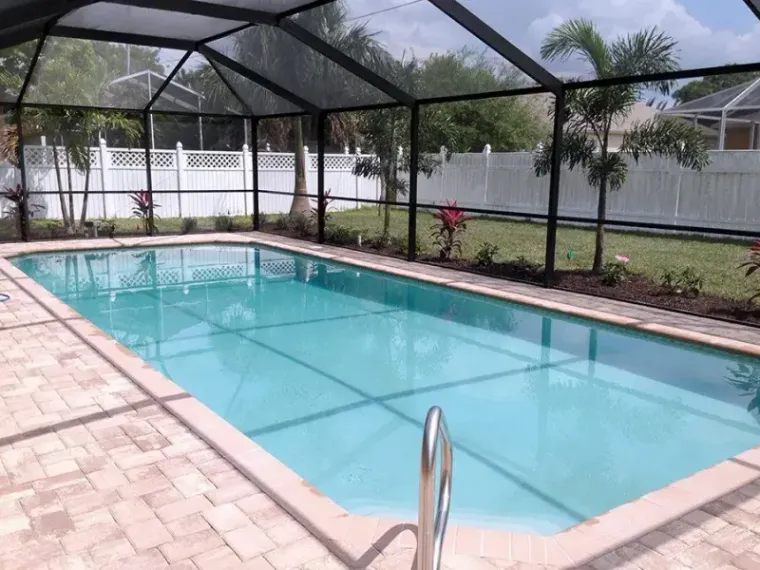
Vinyl liners are one of the most common ways to finish a pool in Florida, and for good reason. They're smooth underfoot, they come in dozens of patterns, and a well-installed liner can look sharp for years. But vinyl doesn't last as long as a hard finish, and eventually every liner needs to be replaced. The question homeowners usually ask us isn't whether it needs replacing, it's how to tell when.
Fading and chalky texture aren't just cosmetic
Sun exposure is constant here, and over years of Florida sun and pool chemicals, vinyl loses its color and can start feeling slightly rough or chalky rather than smooth. A little fading on its own isn't an emergency. But once the surface texture changes, that's the material itself breaking down, not just a stain that needs scrubbing.
Wrinkles, folds and loose spots along the wall
A liner is stretched and fitted to your pool's exact shape when it's installed, and it should sit flat against the shell. If you start noticing wrinkles forming, folds near steps or corners, or sections that feel loose when you press on them, the liner has shifted or stretched beyond where it was designed to sit. This tends to get worse rather than better, and it's often the clearest early sign something needs attention.
Water loss that isn't explained by evaporation
Every pool loses some water to evaporation, especially in a Cape Coral summer. But if you're topping off noticeably more than usual, a pinhole leak or a small tear in the liner is worth ruling out. Small tears don't always show themselves as an obvious flood. Sometimes it's just a pool that seems to need water more often than it used to.
Cracks or brittleness, particularly around steps and fittings
The areas around steps, light fixtures and skimmer fittings do the most work in a liner, because they flex and get walked on. Cracking or brittleness in those spots usually shows up before the flatter wall sections show any wear at all, which is why it's worth a close look at those areas specifically rather than just glancing at the water from a distance.
Why a custom fit matters more than people assume
No two pools are built exactly the same, even ones that look similar from the deck. Steps, corners, light niches and skimmer cutouts all sit in slightly different places from one pool to the next, which is why a liner cut to generic dimensions rarely lays flat the way a liner cut to your pool's actual measurements does. A liner that doesn't fit precisely is more prone to the wrinkling and loosening that ages a pool faster than it should, which is part of why custom fitting matters more than the pattern or color you pick.
What a custom-fit replacement actually involves
- The pool is drained and the old liner removed
- The shell underneath is inspected and any wall or floor issues are addressed before the new liner goes in
- A new liner is cut and fitted to your pool's exact measurements, not a stock size
- The pool is refilled and the water is balanced before you swim
What happens to the shell while the pool is drained
A liner replacement is also the one point in a pool's life when the shell underneath is fully exposed and easy to inspect. Small issues with the walls or floor that would otherwise stay hidden under the liner for years get caught here, while the pool is already empty and accessible, rather than being discovered later as a bigger, more disruptive repair. It's worth treating this stage as a checkup for the whole pool, not just a cosmetic refresh.
How long does a liner actually last
There's no single number that applies to every pool, since sun exposure, water chemistry habits and how much the pool gets used all affect how a liner ages. What's consistent is the pattern: fading and texture change first, then wrinkling or loose spots, then the water-loss and cracking signs that mean it's time to act rather than watch. Catching it in that early-to-middle window, rather than waiting for a visible tear, is what keeps a liner replacement a planned project instead of an emergency one.
Choosing a new pattern doesn't mean starting from scratch
Replacing a liner is also a chance to update the look of a pool that's otherwise structurally sound, without the cost of a full rebuild. Pattern and color options have moved on considerably from what may have been available when your pool was first built, so it's worth treating a liner replacement as a small design decision, not just a maintenance task to get through.
We've installed thousands of vinyl pool liners across Cape Coral, Fort Myers and the rest of Lee County, and our custom-fit liners carry what we believe is the best warranty in the business. If any of the signs above sound familiar, it's worth a free in-home look before a small issue turns into a bigger repair.
Craig's Pacific Pools, 239-458-8600
Call 239-458-8600More articles
What Actually Happens When a Custom Pool Gets Built
From the first sketch to the final walkthrough, here's what building a custom pool in Cape Coral really looks like.
Choosing Pool Features That Actually Get Used
Every feature looks good in a photo. Here's how to figure out which ones you'll actually use.